Behind MUVES · Article · Part 1 of 3
34 AI agents do our routine work. None of them can press send.
MUVES OS drafts, sorts, researches and reviews for a two-person company every day. The rule that matters most is the one that stops it from sending anything.
In brief
- MUVES OS is one assistant, Arthur, in front of 34 narrow agents in nine departments.
- Plain rules route a request before any model guesses, and every model choice is logged with its reason.
- Nothing leaves on its own. Drafts stop with a person, and that rule lives in the code, not in a prompt.
MUVES is two people. Between us we handle clients, building, research and the money, and the routine work piles up fast: notes, follow-ups, first drafts, summaries. We tell businesses that software should take the copying, chasing and remembering off their plate, so we built a system that does it for us first. We call it MUVES OS.
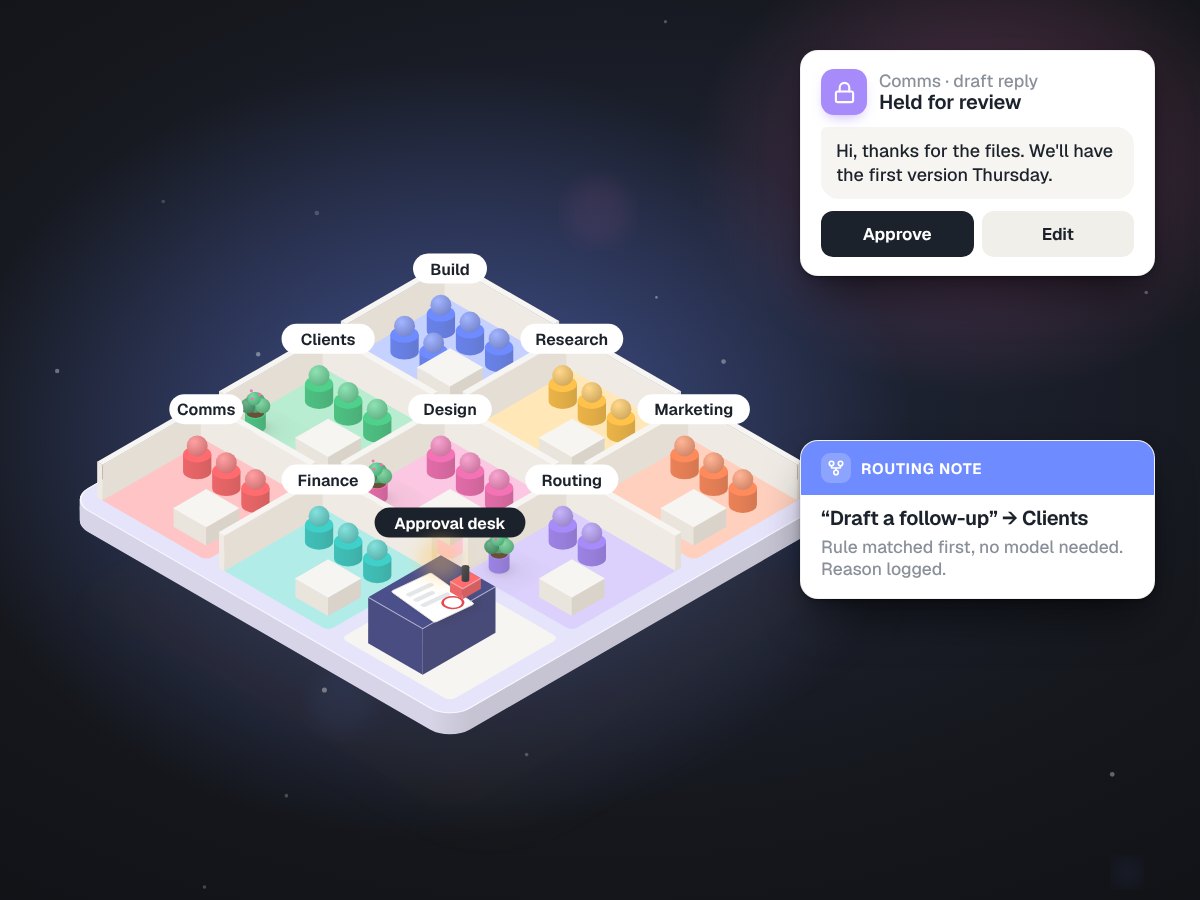
It runs on Reggie's PC around the clock, with a dashboard we can open from our phones. We talk to one assistant, Arthur, by text or voice. Behind him sit 34 agents in nine departments.
What an agent is here
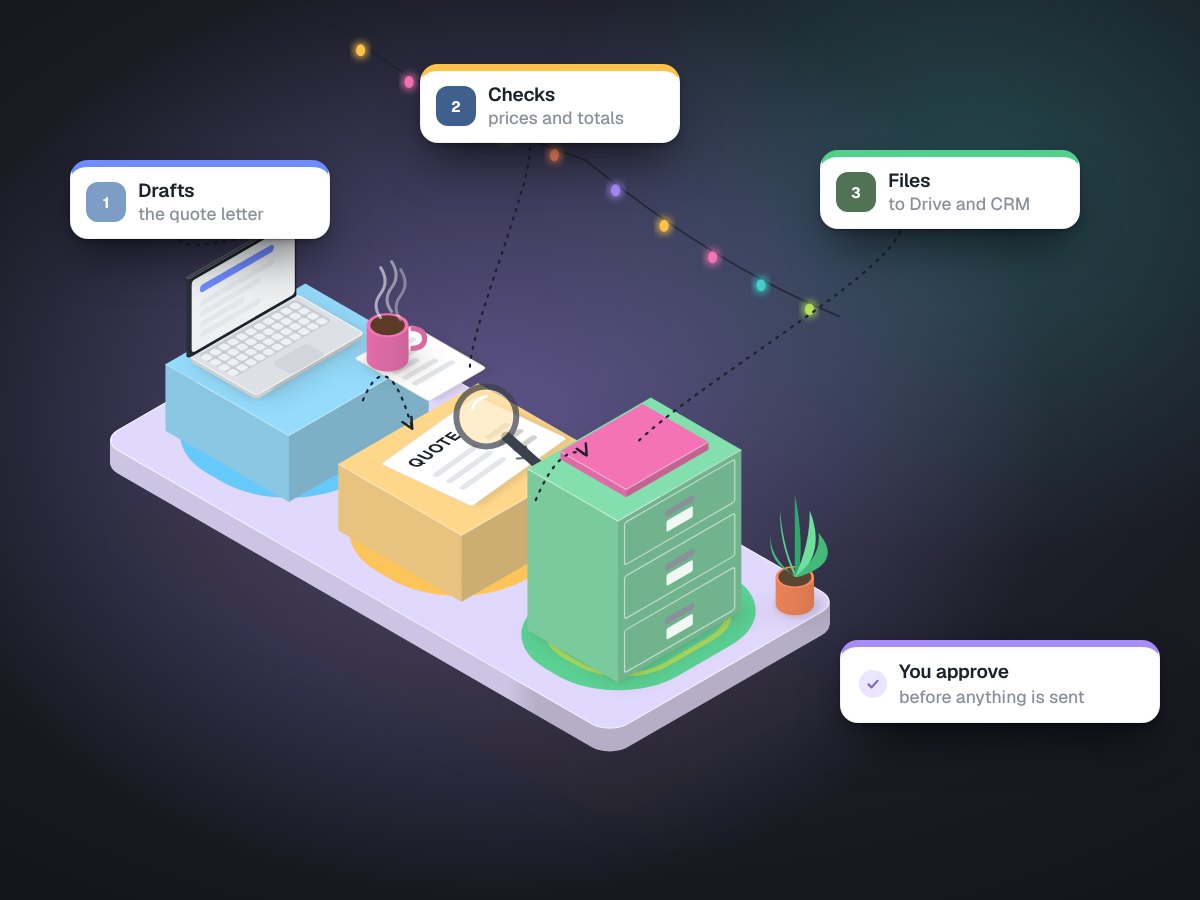
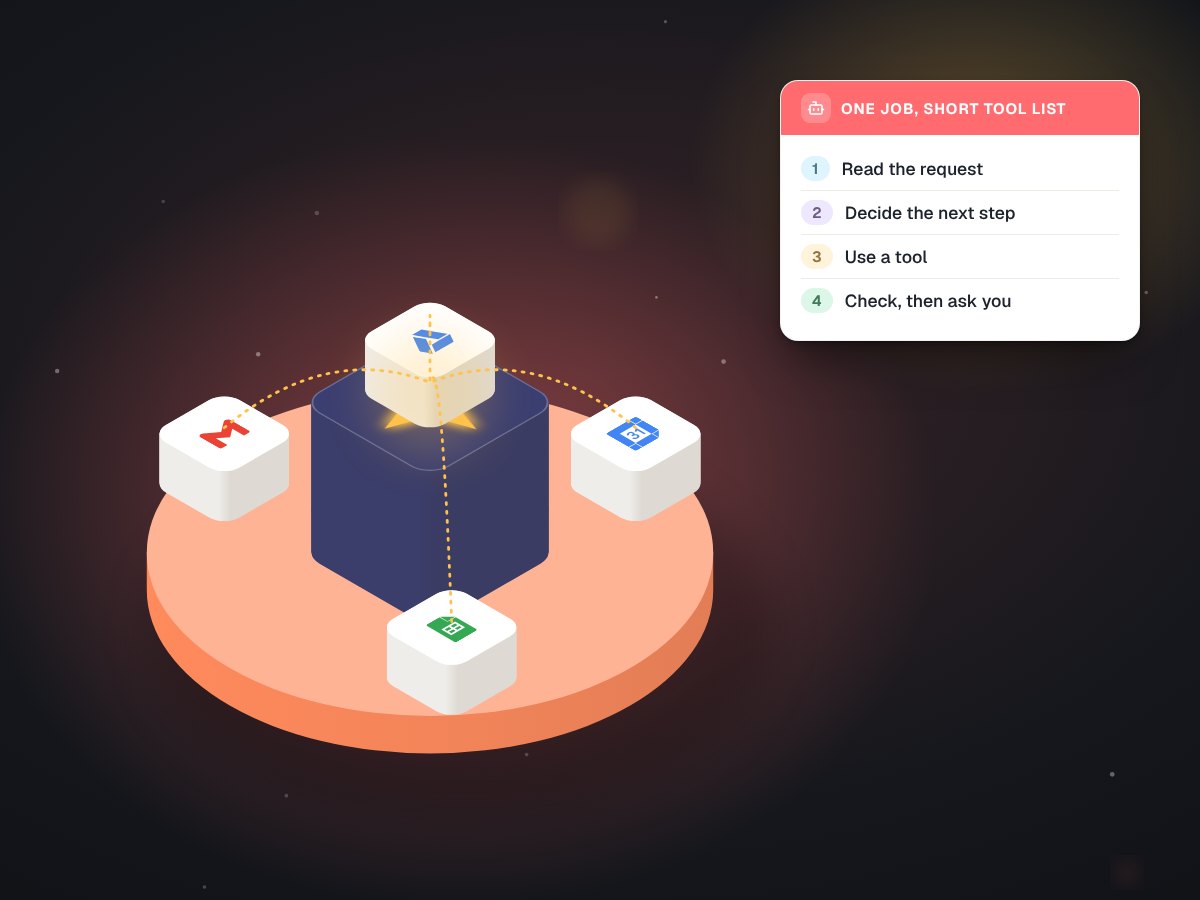
"34 agents" sounds grand until you see how narrow the jobs are. An agent in our system is a job description: a set of instructions, a model to think with, and a short list of tools it is allowed to use. One drafts client follow-ups. One checks pages for broken links. One logs expenses from a sentence like "paid the domain renewal today". Most of them do one thing.
That narrowness is the point. A narrow job is easy to test, easy to review and easy to replace when a better model comes along.
How a request travels
Small talk is answered on the spot. Everything else goes through a short pipeline:
- Rules first. Plain, deterministic rules decide the cases they are sure about before any model guesses. We learned that one the hard way: a small model once read "draft an email to" a client as small talk.
- Then the right model, with a reason. The system chooses between a local model on the PC and cloud models, based on the work, what is available and how costly a wrong answer would be. Every choice is logged with its reason, so a wrong turn can be traced.
- Then house style. Some rules are enforced in code rather than asked for in a prompt. We asked nicely first. It did not work.
- Then review. Anything meant to leave the company is held while the head of that department reads it.
- Then memory. The result goes into the agent's notes and our company vault, so the next answer starts from what we already know.
Why none of them can send
The rule we care about most is written into the system itself: nothing is sent on its own. Drafts stop with a person. A wrong draft costs us ten seconds. A wrong email to a client costs trust, and models can be confidently wrong in ways review does not always catch. Our names are on everything that leaves, so one of us decides to send it.
A wrong draft costs ten seconds. A wrong email costs trust.
Two more rules sit next to it. Never show fake data: an empty screen says what it is waiting for instead of filling itself with examples. And never invent activity: if it is quiet, it says it is quiet.
Earning autonomy, one job at a time
Every repeatable job in the system has a written workflow: the steps, the agents that do them, what the human owns, and a ladder with three rungs. Human-led, human-assisted, autonomous. Moving a job up a rung is a decision we make on purpose, never something that happens by drift. Client follow-up is marked as never autonomous.
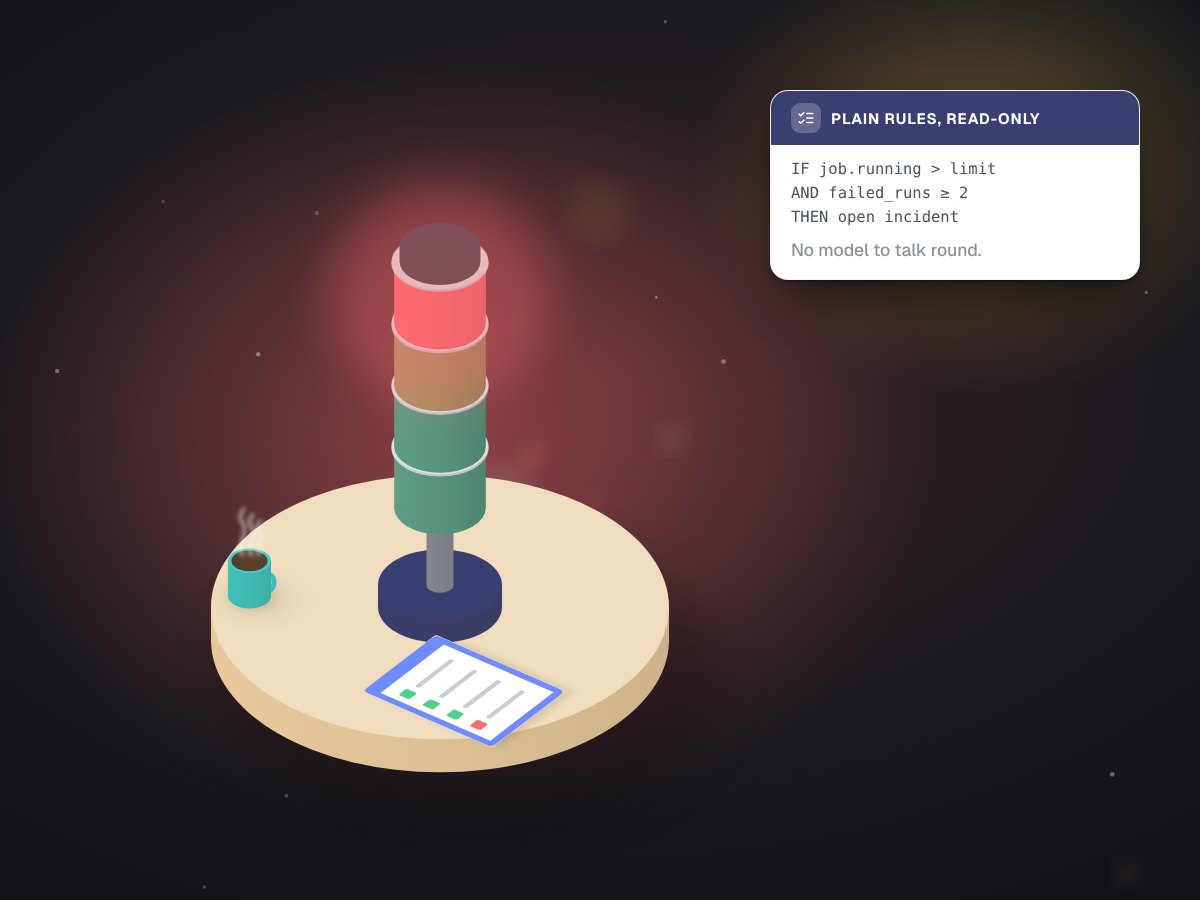
The system is tested like any other software we ship: 62 checks run with every change, a separate monitor watches the agents with plain rules (we wrote about it), and a router benchmark checks that requests land in the right place.
What broke along the way
It has not been smooth. A local model once silently ignored the end of a long prompt, because its default memory window was far smaller than the prompt; nothing errored, the answers were just worse. We found it by testing each agent against real jobs and fixed it by giving the model a larger window. Thinking mode on another model broke structured answers until we switched it off for routing, after which the router got 12 out of 12 test requests right in about a second each.
What it gives two people
It does not run the company. It runs the routine, so we can spend our time with clients and on the build. Notes get written. Research comes back with sources. Follow-ups are drafted and waiting when we sit down in the morning.
We build the same idea for clients, at whatever size fits: an assistant that sorts an inbox, writes a morning brief and drafts replies that wait for approval. Read the MUVES OS case study for the architecture, or see how we approach multi-agent systems for a business.