A quiet month means nothing. Unless it is your weekly customer.
Your order history already knows who is drifting away. We read it customer by customer, judge each one against their own buying rhythm, and hand you a short list of who to call and why.
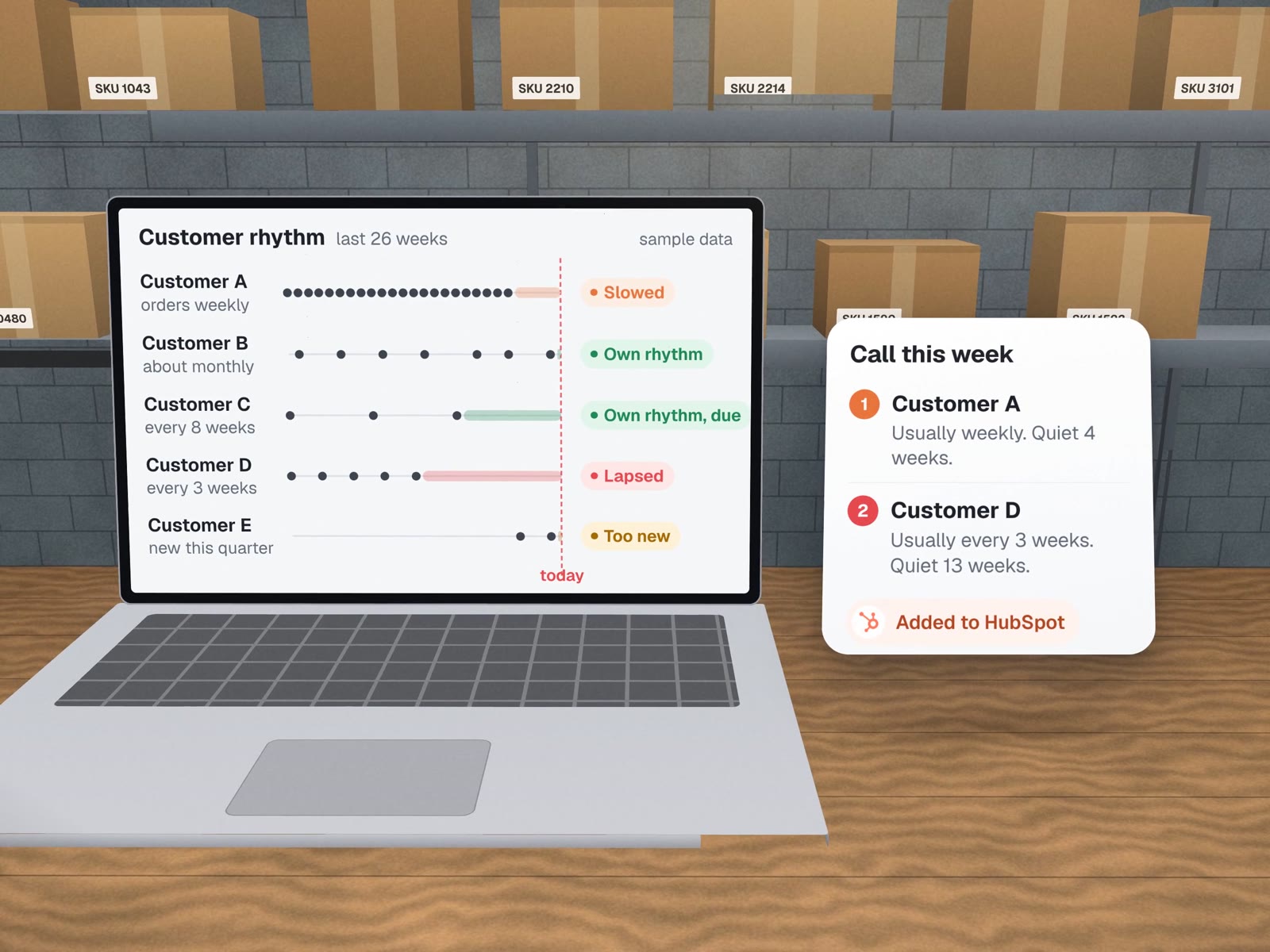
Five customers, one rule for all, and why it fails.
Sample data. Each dot is an order over the last 26 weeks. The common shortcut, "flag anyone with no order in five weeks", gets two of these five wrong.
Every customer lands in one of four groups.
Each with a suggested next step. You decide which ones to act on.
Buying at their usual pace, even if the gap looks long.
Next step: leave them alone.Still buying, but noticeably less often than their own normal.
Next step: a friendly check-in.Quiet for several times their usual gap.
Next step: a personal call from the owner.Too few orders to know what normal is.
Next step: watch, do not judge.25,336 cases, one practice at a time.

For Carlos Ceramics Dental Lab we analysed 25,336 cases from the lab's own system backup to see which dental practices were sending work at their usual pace. We worked on aggregates only: the patient table was never extracted.
The obvious approach, one threshold for every practice, never fired once when we tested it against the lab's history, because small practices order rarely and big ones often. Judging each practice against its own pattern over at least four weeks is what worked.
The analysis also surfaced problems nobody had asked about:
- A status field wrong both waysA field in the lab's own system that was wrong in both directions.
- Duplicate recordsThe same practice entered more than once.
- A hidden groupA multi-location group behind a single contact.
- Shared phones and emailsSeveral practices on one number or address, which made per-practice messages unsafe until they were separated.
The results then went into the lab's CRM with a full audit trail. Read the case.
Findings, lists and the method to rerun them.
- One clean tableYour orders, invoices or cases cleaned and joined.
- A profile per customerUsual gap, last order, direction of travel, verdict.
- A short written reportWhat we found, how sure we are, what we would do.
- A call list for this weekOrdered by what is at stake for you.
- Data problems foundEach with a suggested fix.
- The scriptsSo the analysis can run again next quarter or every Monday.
What we need: exports or a backup going back as far as you have, the two questions you most want answered, and an hour with whoever knows why the odd records are odd.
About reading order history.

We sell to the public, not to accounts. Does this still work?
Yes, as long as repeat buyers can be recognised, by loyalty number, email, phone or card token from your payment system. One-off shoppers go in the "too little history" group.
Can it run automatically after the first analysis?
Yes. Once the method is agreed, the same script can run weekly and add new "slowed" customers to your CRM or your morning brief.
What if our data has gaps or a system change in the middle?
We mark the break, judge customers only on the periods we can trust, and say in the report which conclusions it weakens.
More on customers who drift
From the finding to the phone call.
Who were your best customers two years ago?
If you are not sure they still are, book a free call. We will tell you what your records can answer.