Campaigns that reach people, without switching your email off.
A few thousand old contacts and one big send is how small businesses get their sending paused. We clean the list, set up the domain properly, warm it up slowly and stop each send before it crosses the platform's own limits. You approve every message.
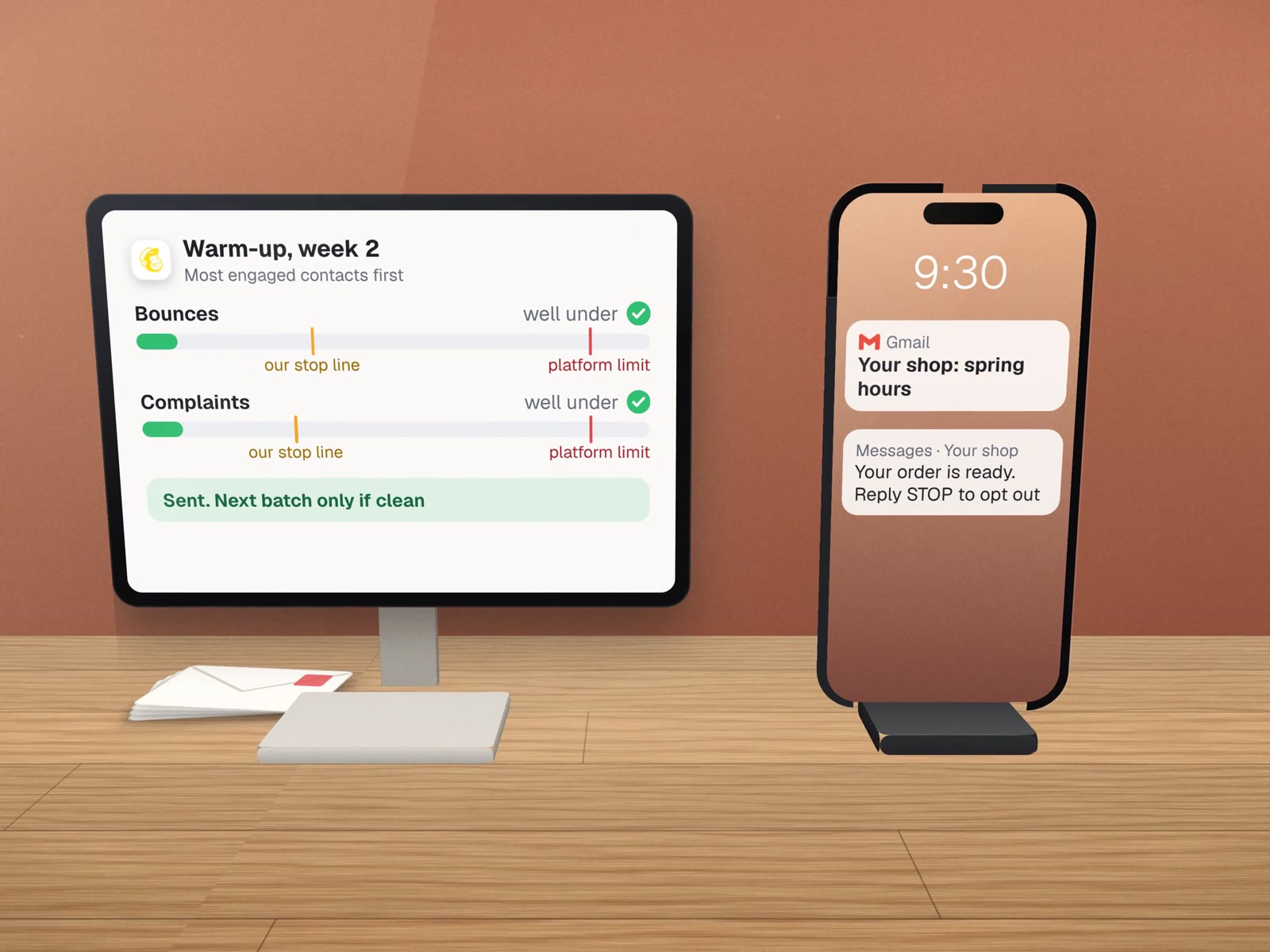
Published limits, and where we stop.
Platforms publish the point at which they pause your sending. We set our own stop line well before it, so a person decides what happens next while there is still room.
- HighLevel shuts a domain at
- 5%
- Our stop line
- Well below, set per list
- HighLevel shuts a domain at
- 0.05%, about 1 in 2,000
- Gmail and Yahoo bulk-sender rule
- Stay under 0.3%
- Bounces and complaints
- Per batch
- Domain reputation
- Google Postmaster Tools
Limits are as published by the vendors when we checked; we re-check them for your platform before the first send.
 GmailYahooGoogle Postmaster Tools
The sending domain, record by record.
| Record or step | What it does | How we set it |
|---|---|---|
| Dedicated sending subdomain | Keeps campaign reputation apart from your everyday mail | One per platform, inside your CRM or email tool |
| SPF | Lists which services may send as you | Only the services you actually use |
| DKIM | Signs each message so it cannot be faked in transit | Keys from your sending platform |
| DMARC | Tells inboxes what to do with mail that fails the checks | Start at "report only", then move to "quarantine" |
| MX and tracking records | Replies and link tracking work on the subdomain | As your platform specifies |
| Postmaster Tools | Google's view of your domain's reputation | Connected and checked weekly |
| Separate domain for cold outreach | If you do any, it can never damage your main name | A related domain, never your main one |
Two to four weeks of small sends first.
A new domain has no reputation. It earns one by sending a little, to people most likely to open, and growing only while the numbers stay clean.
3,825 contacts checked before a single send.
Carlos Ceramics Dental Lab wanted to reach dental offices that did not yet send it work. The guardrails came first. As of today, nothing has been sent from that list.
- Segmented
- 3,825 contacts into 3 segments, by API, verified by reading each tag back
- Excluded by construction
- Existing customers and anyone already emailed
- Domains checked
- All 665 email domains DNS-checked; 29 dead addresses removed
- Send order
- Practice domains first; about three quarters were personal inboxes
- Left switched off
- 3 existing workflows that could have messaged people unseen

We also read the lab's own past sends. Deliverability was fine. The problems were copy and targeting: the same email sent twice to some people, introductions sent to existing customers, and a broken name field that greeted people as "Dr. Doctor". That is now a standard check before we write a single new campaign.
Shorter, rarer and only with permission.

Permission on record
Only people who agreed to receive texts from you, with a record of when.
"Reply STOP" on every message
Honoured automatically.
A registered sending number
A2P 10DLC in the US.
Useful content only
An order ready, a seasonal reminder, a returning-customer offer you approved.
Where it fits.
- Shops and online storesPast buyers who opted in.
- SuppliersNew products announced to existing accounts.
- Clinics and labsKeeping in touch with the practices and patients who asked to hear from them.
- Venues and event businessesSeasonal calendars.
About sending.
Can you guarantee our emails land in the inbox?
No one honestly can. Inbox placement is decided by Gmail, Outlook and the rest. What we control is everything that makes good placement likely: authenticated domains, a clean list, a slow warm-up and messages people expect.
Why a separate domain for sending?
So that a campaign problem cannot hurt the address your customers and suppliers write to every day. Marketing goes out from a dedicated subdomain or a related domain; your everyday mail keeps its reputation.
We bought a list years ago. Can we use it?
We will not send to it. Lists without a clear record of how people agreed to hear from you are the fastest way to complaints and a paused account. We help you build from the customers and inquiries you already have.
Do text campaigns follow the same rules?
Stricter ones. Texts go only to people who agreed to receive them, every message carries a way to stop, and the sending number is registered with the carriers. This is a plain-language summary, not legal advice.
Before and after the send
The pieces around a campaign.
Thinking of emailing the whole list? Talk to us first.
A free call to check your domain and list before anything goes out.