The right questions asked first, and every request on the right desk.
An agent that asks your intake questions by chat, phone or form, checks the answers against rules you wrote, and routes the request: book it, call today, refer it elsewhere, or ask once more. Nobody prices a job with half the details again.
From seven answers to one route.
A made-up kitchen and bath contractor, Sample Renovations. The fields and rules change per business. The shape does not.
Intake that works the same at 9 am and 9 pm.

Questions written once
Asked the same way on chat, phone and your website form.
Answers as fields
Saved in your CRM, not buried in a chat log.
Fit rules you can read
Service area, job types, minimum size, urgent words.
Existing customers first
Checked before anything enters the sales queue.
Booking for good fits
Straight into the right person's calendar.
A weekly "not a fit" list
See what you turned away and change the rules.
Three real builds already do parts of this.
We have not built a conversational intake agent for a client. Its pieces come from work that runs today.
- Structured intakeThe quote builder we built for Conception Design, a sign and print shop, asks for the product, quantity, print placement and artwork, in English or Spanish, live since September 2026. See it.
- Check before spendingLabelBot, our invoice-to-label automation for a dental lab, asks the courier whether an address is in its service area before buying a label. Intake should check fit before anyone drives out. See LabelBot.
- Existing customers firstWhen we segmented 3,825 prospects in a dental lab's CRM, existing customers and people already emailed were left out by construction, not by someone remembering.
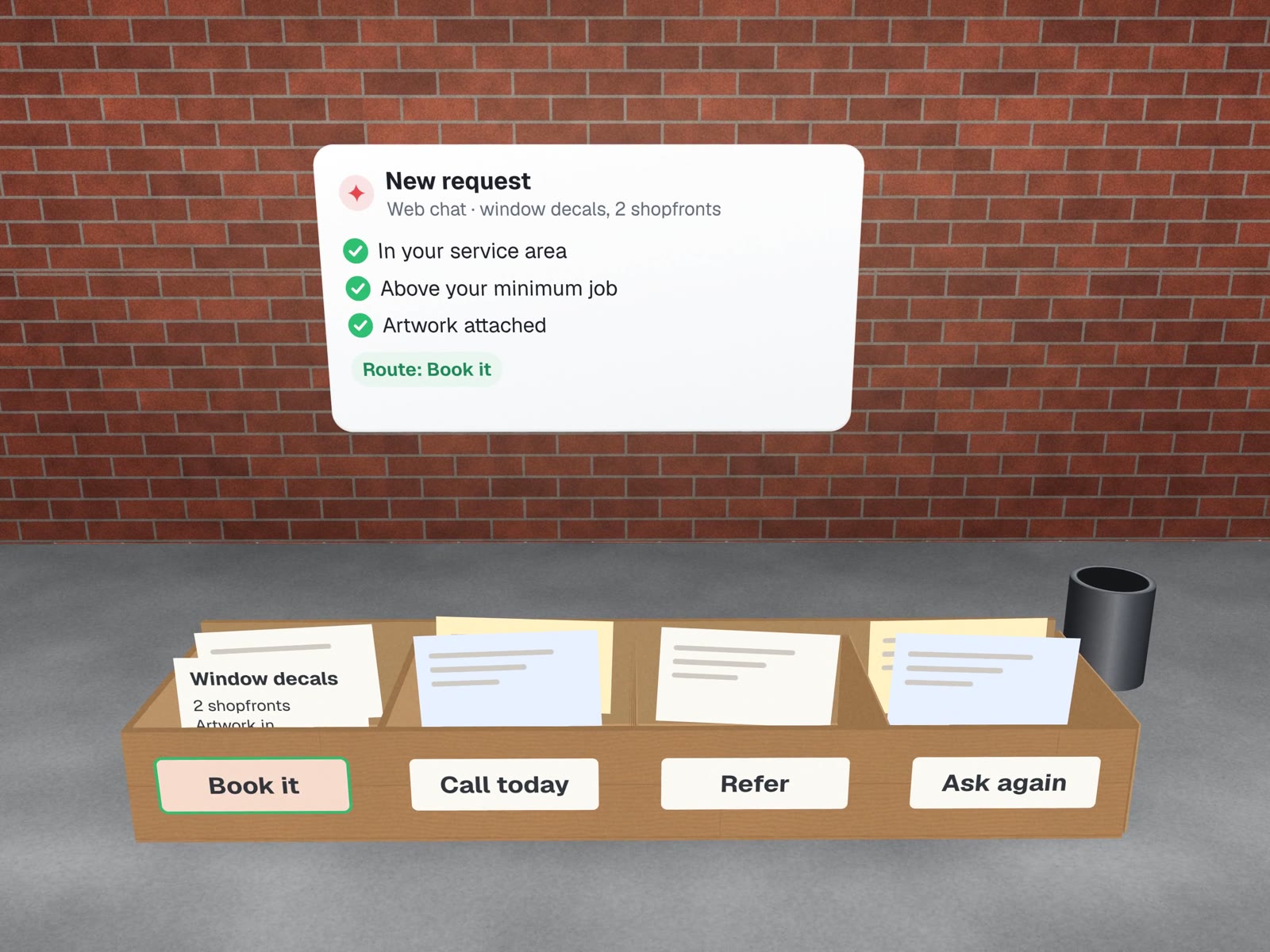
Tested on last month's requests.

- We take a month of your real enquiries, with names removed, and write down where each one should have gone.
- The rules run against all of them. Every disagreement is either a rule to fix or a case for a person.
- Staff play customers on each channel, including the vague and the rude.
- It goes live with a person reading every route for the first weeks, starting with the "not a fit" replies.
What we need from you
- Your pre-quote questionsThe ones you ask before you price anything.
- Service area and minimumsWhere you work and the smallest job you take.
- Who handles whatWhich person gets which kind of job.
- A month of past enquiriesTo test the rules against.
About sorting enquiries.
Will it turn away customers we would have wanted?
Not on its own. A request that fails a rule gets a polite answer and still lands in a list a person reads. For the first weeks, someone reviews every "not a fit" before the reply goes out.
Is the score decided by AI?
No. The AI collects the answers in conversation. The checks are plain rules you write and can read, like a service-area list or a minimum job size, so the same answers always get the same route.
What if they are already a customer?
The agent checks your records first. An existing customer goes to whoever looks after them, not into the new-lead queue.
Where intake connects
The channels it runs on, the CRM it writes to, and the builds it borrows from.
Website chat & WhatsApp
The conversations intake runs inside.
Sales pipeline design
Stages and owners for what intake sends on.
Online quotes & booking
The same questions as a guided form.
Bilingual site with a quote builder
Structured intake, live since September 2026.
Construction & trades
Where a site visit is expensive to waste.
What do you always ask before you quote? Start there.
On a free call we write your intake questions and routing rules on one page, and you can use that page whether or not you build the agent.